

You were promoted because you were exceptional at your job — the go-to person, the one who got things done. Now, as a first-time manager, the very thing that made you successful is the thing you need to release. This is the central paradox that trips up so many new leaders, and mastering delegation skills for first-time managers is the key to breaking through it.
Here’s the uncomfortable truth: holding onto tasks because «it’s faster if I just do it myself» isn’t efficiency — it’s a ceiling. It limits your team’s growth, caps your impact, and quietly signals that you don’t trust the people you’re supposed to be leading. The shift from individual contributor to manager isn’t just a title change. It’s a fundamental rewiring of how you define your own success.
The good news? Delegation is a learnable skill, not a personality trait. And once you crack it, everything changes — for you, your team, and your results.
In this article, you’ll discover why delegation feels so difficult at first, the most common mistakes new managers make, and a practical step-by-step framework to start delegating with confidence, clarity, and control.
Why Delegation Is the #1 Skill First-Time Managers Must Master
The promotion felt like the finish line. In reality, it was the starting gun for an entirely different race — one where your old playbook of working harder and doing more will quietly sabotage your success.
Here’s the uncomfortable truth most new managers learn too late: the skills that earned you the promotion are not the skills that will make you effective in the role. And nowhere is that gap more glaring than in delegation.
Gallup research reveals that managers who delegate effectively generate 33% more revenue than their less-trusting counterparts. Yet studies consistently show that first-time managers spend more than 40% of their time on tasks that could — and should — be handled by their teams. That’s nearly half your week spent doing yesterday’s job instead of leading today’s.
The cost compounds quickly. When managers can’t let go, they become the bottleneck. Projects stall, team members disengage, and burnout creeps in. The American Institute of Stress links managerial burnout directly to the inability to distribute workload — and it’s one of the leading reasons promising managers derail within their first two years.
But the barriers are understandable. Fear of losing control, perfectionism, and a nagging distrust that «no one will do it quite right» are deeply human responses to newfound responsibility. They feel like caution; they function like ceiling.
Effective delegation isn’t about doing less. It’s about unlocking team growth, building your own strategic capacity, and creating a operation that scales beyond any single person — including you.
The SMART Delegation Framework for New Managers
Delegation isn’t just about handing off tasks — it’s about setting people up to succeed. Use the SMART Delegation Framework to make every handoff intentional and effective.
Scope: Start by defining exactly what needs to be done. Describe the expected output in concrete terms and establish clear quality standards. Vague instructions lead to disappointing results, so the more specific you are upfront, the less rework you’ll face later.
Match: Not every task belongs to every person. Align the work to a team member whose existing skills fit the challenge and whose growth goals benefit from taking it on. The right match builds confidence and keeps your team developing.
Authority: One of the biggest mistakes new managers make is delegating responsibility without delegating authority. Be explicit about which decisions your team member can make independently and which ones require your input. This clarity removes hesitation and speeds up execution.
Resources: Before someone can perform, they need the right tools, information, and access. Confirm they have everything required — data, software permissions, budget, or key contacts — before the work begins. Removing blockers early prevents frustrating delays.
Timeline and Check-ins: Set clear milestones and agree on check-in points upfront. The goal is accountability, not surveillance. Scheduled touchpoints give you visibility without hovering, and they give your team member a safety net if challenges arise.
—
Know Who You’re Delegating To: The Skill vs. Motivation Matrix
Before delegating, quickly assess where your team member falls in this simple 2×2 matrix:
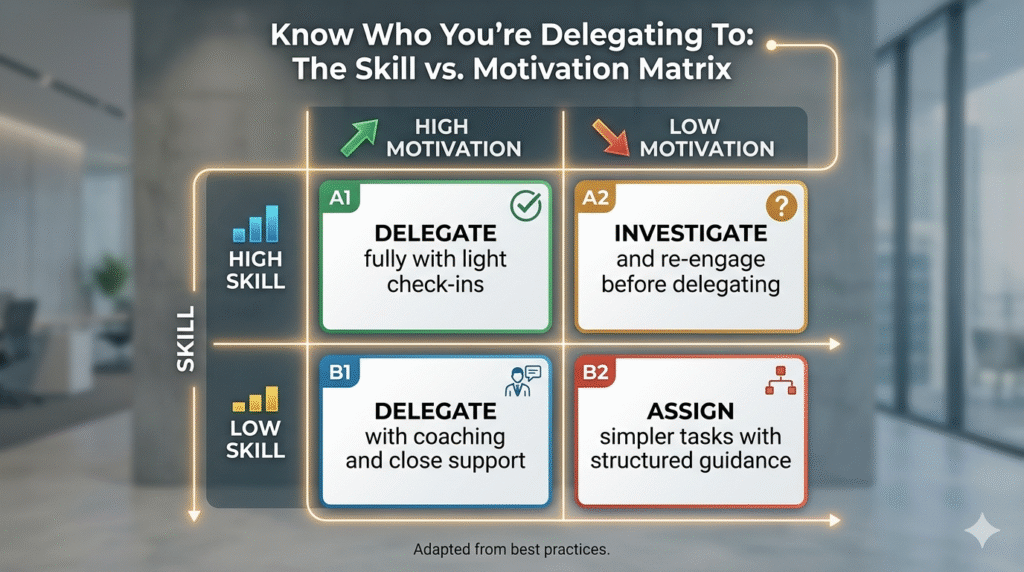
Matching your delegation style to someone’s current skill and motivation level isn’t micromanaging — it’s smart leadership.
5 Steps to Master Delegation as a First-Time Manager
Delegation doesn’t happen by accident — it’s a skill you build deliberately. Follow these five steps to start handing off work with confidence.
Step 1: Audit Your Task List
Start by writing down everything on your plate. Then draw a hard line: which tasks require your specific authority or expertise, and which ones could realistically be handled by someone on your team? Be honest. Most first-time managers discover that far more tasks are delegable than they initially assumed.
Step 2: Match Tasks to Team Members
Delegation isn’t just about offloading work — it’s about intentional assignment. Consider each team member’s current strengths *and* their growth goals. Giving someone a stretch task that aligns with where they want to develop turns delegation into a coaching opportunity.
Step 3: Brief Clearly Using the 5 W’s
Weak briefings create confusion and rework. When you hand off a task, cover the five W’s: what needs to be done, why it matters, who is responsible, when it’s due, and what success looks like. This is where strong delegation skills separate good managers from great ones.
> Example delegation script: *
«Sarah, I need you to prepare the Q3 client summary report by Friday at noon. It should be two pages max, highlight our top three wins, and be ready to share with the executive team — that’s the audience, so keep the tone professional and data-driven.»
Step 4: Set Check-In Points Without Micromanaging
Define milestones, not methods. Agree upfront on two or three scheduled check-ins so your team member knows when to surface blockers — without feeling watched. Trust the process you’ve set, not just the outcome.
Step 5: Debrief After Completion
Every delegated task is a coaching opportunity. After delivery, spend ten minutes reviewing what went well and what could improve. Ask, listen, and adjust. Done consistently, this habit builds capability faster than any training program.
Common Delegation Mistakes New Managers Make (And How to Avoid Them)
Even well-intentioned managers fall into these traps. Here’s what to watch for:
1. Delegating only the tasks you dislike. Offloading your least favorite work isn’t a development strategy — it’s avoidance. Delegate meaningful tasks that stretch your team’s capabilities.
2. Checking in too frequently. Constant follow-ups signal distrust and kill motivation. Set clear milestones upfront, then step back and let your team deliver.
3. Not providing enough context. Your team members can’t read your mind. Before handing off a task, explain the *why*, the expected outcome, and how success will be measured.
4. Delegating the task without delegating the authority. If someone can’t make decisions or access resources needed to complete the work, you haven’t truly delegated — you’ve just created a bottleneck with extra steps.
5. Failing to acknowledge effort and results. Recognition closes the loop. When your team delivers, say so. It builds trust and reinforces the behaviors you want to see again.
—
Delegation isn’t something you either have or you don’t — it’s a skill you build with intention and practice. Mastering delegation skills for first-time managers means learning to trust your team, communicate clearly, and lead through others rather than around them. When you do, you stop being the bottleneck and start becoming the leader your team actually needs.
Ready to grow faster in your leadership role? Explore Mindslines coaching programs or book your free discovery call today at [mindslines.com](https://mindslines.com).

 info@mindslines.com


